I am sitting in a room.
In "I am sitting in a room" (1969), Alvin Lucier records the sound of his voice and plays it back into the room, recording the sound again and again in a loop.
"I am sitting in a room different from the one you are in now. I am recording the sound of my speaking voice and I am going to play it back into the room again and again until the resonant frequencies of the room reinforce themselves so that any semblance of my speech, with perhaps the exception of rhythm, is destroyed. What you will hear, then, are the natural resonant frequencies of the room articulated by speech. I regard this activity not so much as a demonstration of a physical fact, but more as a way to smooth out any irregularities my speech might have."
The sound of his voice is a catalyst more than any expression of meaning or thought. He's using his sound waves to explore the space around him and transfer vibration into the drywall and wood beams and screws and nails so that he can collect the echoes back, altered ever-so-slightly by what they touched. By repeating this technique over and over, one can put the spotlight on the room itself, letting the words melt away.
A few years earlier in 1964, Marshall McLuhan coined the phrase "the medium is the message"—I wonder if Alvin here was being cheeky, having found a strange edge case to the idea. In Alvin's room, is the medium the recording, the walls, the words, or maybe the tape itself?
Tape recorders may be out of date, but that doesn't make it less relevant. Patrick Liddell, in homage to this concept, did this in video in 2010—putting spotlight on the "resonance" of the compression and network algorithms used in transferring video over the internet. In the built environment of the digital world our spaces are made of math and bits and programming code, every bit as tangible to your data as a sheet of drywall in your home.
Space is big.
Douglas Adams notes that "Space is big. You just won't believe how vastly, hugely, mind-bogglingly big it is.", but even space that's just peanuts to math. Graham's number is so large that even if you stored every digit of it the smallest possible volume of space (a Planck volume) it still would not fit in the the observable universe. It simply has too many digits for us to write down. The number itself is very much real in that it is one that can be understood and written down the same way by anyone—yet it exists in a realm that reality simply cannot accommodate.
The Call of Cthulhu contains a story about some sailors who comes across the forgotten city of R'lyeh, where "the geometry of the place was all wrong". As they explore it, some crew members get swallowed up in the non-euclidean architecture and the rest are driven to madness. The space itself is deadly but worse still: "In his house at R'lyeh, dead Cthulhu waits dreaming".
"The Thing cannot be described—there is no language for such abysms of shrieking and immemorial lunacy, such eldritch contradictions of all matter, force, and cosmic order. A mountain walked or stumbled."
Annihilation by Jeff VanderMeer also explores a similarly eldritch space inhabited by creatures and natural processes beyond the description or reasoning of mere mortals. In it, there is a "tower" inhabited by a creature referred to as "the Crawler"
"As I adjusted to the light, the Crawler kept changing at a lightning pace, as if to mock my ability to comprehend it. It was a figure within a series of refracted panes of glass. It was a series of layers in the shape of an archway. It was a great sluglike monster ringed by satellites of even odder creatures. It was a glistening star."
These creatures are not horrifying because of any specific malice or malfeasance, but rather simply because they refuse comprehension by our mortal senses. Perhaps in their own domains they are benign, but to weak creatures such as ourselves even witnessing their existence is an existential threat.
Token haiku time.
Like a lot of people, I've been thinking a lot about AI lately.
Years ago, when Apple first added the predictive word suggestions to the keyboard I enjoyed hitting it repeatedly to make screens full of nonsense text. Sometimes I'd spend time breaking it up into little haiku-like blocks and save the best ones to share with my friends.

Sometimes I'd save strange and unhinged sequences
The fact that the company said the government has been the most important thing in the world is full of it
And or weirdly sweet ones
I just want to see you soon enough to be a great day for me
It's unsettling how many of these start with "I"—are we, statistically this self-centered? Why does this AI model seem to imply that we only ever talk about ourselves?
AI has come a long way since then, but it still mostly works the same way: predicting which word will come next in the sequence. If you ask an AI app "what color is the sky?", under the hood it's doing this:
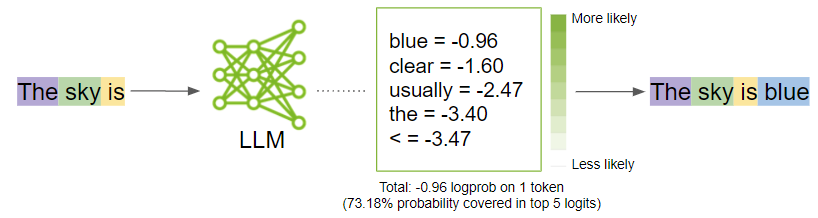
Here, it gives us a clearly-correct answer: the sky is blue. However, there is a less likely answer that it could have provided that was "The sky is usually blue", but its algorithm scores that lower. There are a whole host of answers it may have come up with, but what it come back to your phone with is simply the one it determined to be the most likely.
So if it's just predicting "the next word", what gives? How come it can create pictures and sound now, too? This question helps us see the secret: the "magic word machine" is a magic math machine after all—and to it's alien mechanisms, words and numbers and sound or pixels are all interchangeable and equally viable. It just so happens that we learned how to use it on words first, not that words have some special property.
Make it weirder.
More recently (than my autocorrect haikus), I asked an AI program "make me a resume website". What it returned was the platonic ideal of a resume—exactly what you'd expect to see from someone who took the time and effort to put their resume on the internet in a professional and well-executed way. So, again and again, I asked my AI coder pal to "make it weirder."
A few iterations in it had added strange graphics and animations, but I kept pushing. No matter what it made, all I had to say in reply was "make it weirder". Every few iterations it'd run in to a code problem and I'd work with it to troubleshoot, but the moment it was solved I demanded we get back to improving the weirdness. "Good work, it's running again. Now: make it weirder."
Twenty loops in the website is barely functional. It no longer has any qualifications of any kind, and where we started as "HR and Recruiting Professional", our wholly invented candidate "Alex" is now an "Interdimensional People Weaver" whose experience "transcends reality itself".
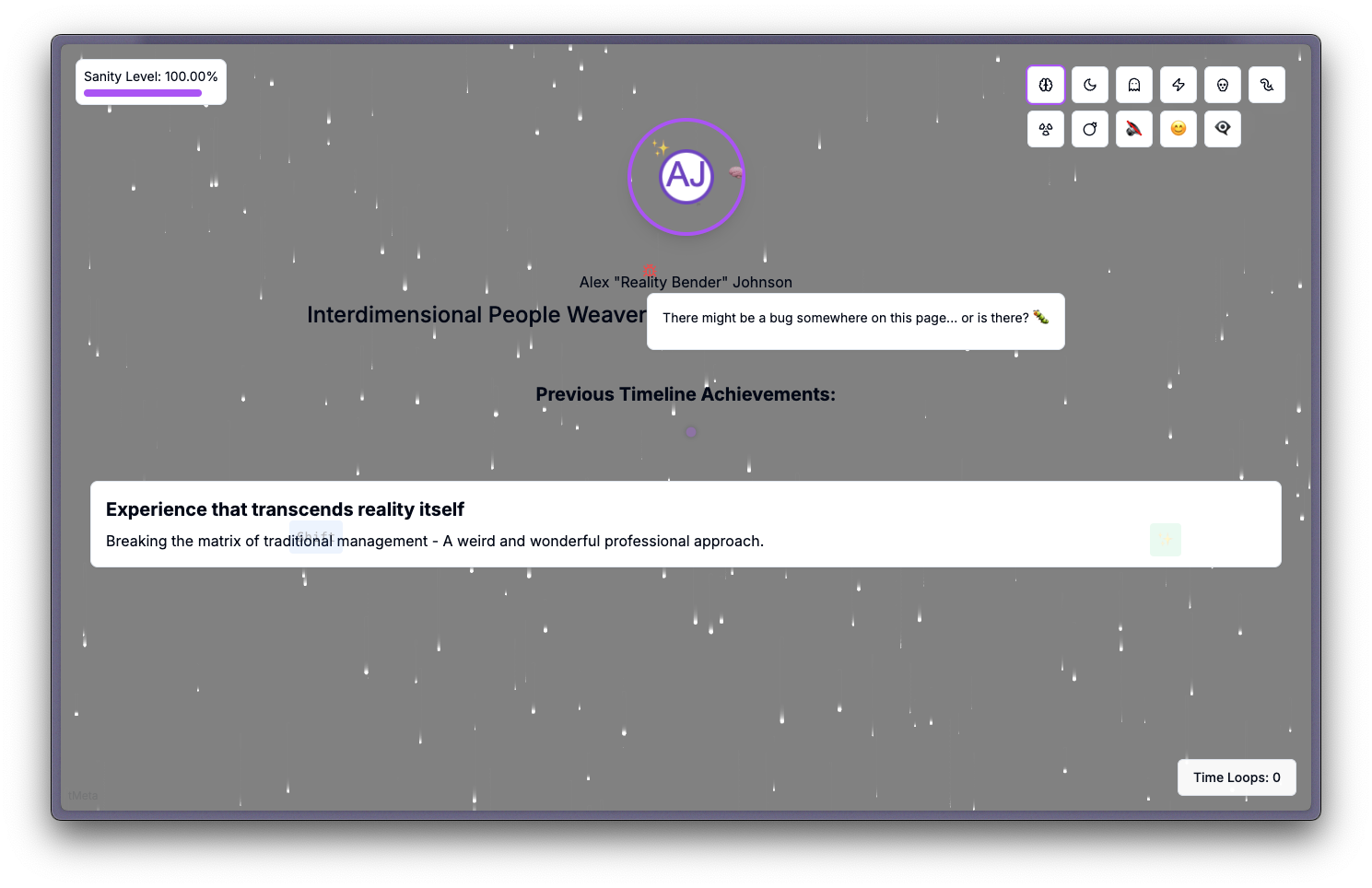
Like Alvin's tape recorders, my looped repetitions are creating a whole new outcome and the message is only serving to express the underlying resonant frequencies in the large language model. What you're seeing are shadows of what's lurking deep within it.
A colleague of mine used AI to build a small website application for managing some daily house routines. Over time he had worked on it so much that the AI had "forgotten" the original purpose—its memory is only so large, and eventually the oldest information starts to disappear when it falls out of the "context window". Instead of his domestic management chores, suddenly he found the AI starting to add e-commerce features to his task management app.
E-commerce, then, is another one of those resonances residing deep within these models. I wonder what else is swimming around in there.
Hyperobjects.
Timothy Morton describes "hyperobjects" as:
- Viscous: Hyperobjects adhere to any other object they touch, no matter how hard an object tries to resist. In this way, hyperobjects overrule ironic distance, meaning that the more an object tries to resist a hyperobject, the more glued to the hyperobject it becomes.
- Molten: Hyperobjects are so massive that they refute the idea that spacetime is fixed, concrete, and consistent.
- Nonlocal: Hyperobjects are massively distributed in time and space to the extent that their totality cannot be realized in any particular local manifestation.
- Phased: Hyperobjects occupy a higher-dimensional space than other entities can normally perceive. Thus, hyperobjects appear to come and go in three-dimensional space, but would appear differently if an observer could have a higher multidimensional view.
- Interobjective: Hyperobjects are formed by relations between more than one object. Consequently, entities are only able to perceive the imprint, or "footprint," of a hyperobject upon other objects, revealed as information.
Typically, hyperobjects are usually thought of as "concepts". Think about global warming or the economy—these are "conceptual" things in that they are a large category of related things, except, in fact, they are a single collective and monolithic mass.
When we talk about "the economy", people tend to think about it as a concept and not a tangible object—but it is very tangible. The economy is all the money, everywhere. Economics is the study of how it moves and reacts to change and growth. Economists study its movement, bankers take little parts of it and store the parts away, investors take some parts and lump them together to make them grow faster, if they're lucky.
Cities are another popular example of a hyperobject. When you point to a dot with a label on a map, that's a reference to the city. The roads and buildings in it are all part of the city itself, and that city exists beyond normal time and space, having tangible relevance to past, present, and future and across that history will take on many shapes and sizes and compass innumerable parts. Cities, being hyperobjects, are viscous, adhering to any object they touch. The citizens and the city are one, and by living in a city you become a part and extension of its mass.
Bananas.
AI is a hyperobject, and by extension, so is its output. If you took a sentence provided to you by an AI, pick it up, and slowly turn it in your hand, what you'd see are not the different sides of the same answer but entirely new answers on each side.
Imagine a diamond where each facet reflected a different material when it caught the light. Some shone as diamonds or rubies or emeralds, some were concrete or wood, and some fish scales and viscera. Depending on how you hold it it certainly might be a beautiful and pristine, but at the right angle and in the right light that same object can reflect a vile and rotten pile of putresence.
But we're monkeys who grew up living in three dimensional space. As a monkey, we want a banana so that we can eat it. If we open a magic box and see bananas in it, of course we're going to eat three and then call our friends over for the rest. Turns out, when I close the box and open it again, it's full of bananas again—a boundless supply!
Now that we have infinite bananas, my friends and I are exploring what we can do with them—can we feed the world? Build houses? Manage the economy with them? Perhaps we could use them to fire all those slackers in the government?
Unfortunately, these are not bananas. These are banana-shaped expressions of a data model trained on billions of parameters and further tuned with dozens or hundreds of hyperparameters to meet the spec of the creator.
We are the sailors exploring R'yleh. Hobbits who stumbled across a (precious) magic ring. We're guests staying at The Overlook Hotel in the off-season.
Arthur C. Clarke noted that "any sufficiently advanced technology is indistinguishable from magic", and in this instance I think the line is best-read literally. It's not merely that the technical details of these technologies seem magical and out of reach for most people, it's also that the effects of that technology have properties not unlike incantations of a spell. Mere mortals should not be wielding magic unsupervised.
As the March of Progress shows us walking into our AI era I don't think we can slow that progress down. The impact and utility of these tools for our society are far too great and—what will be even harder to stop—their ability to be capitalized into products is massively lucrative. There is no chance that we'll see a Butlerian Jihad that bans the creation of thinking machines any time soon.
Staying safe.
Growing up, my father had workshop where he designed and built custom electronics for clients. Two of my favorite things to play with as a kid were his 5lb jar of mercury which I'd scoop a big lump out of and swirl around in glass jars or make my toys float on the surface of, or a MAPP gas torch which he let me melt lead in a crucible and pour it into little graphite molds.
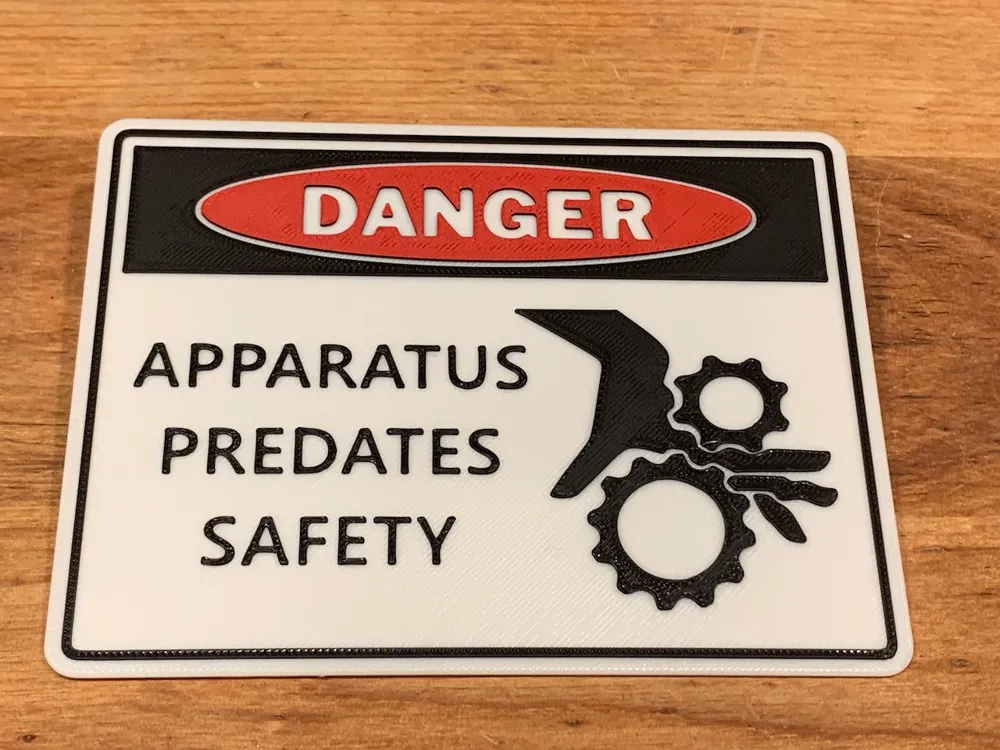
My dad's shop predated safety—but that's not to say I was not safe. Growing up, much of my time not playing with mercury and blowtorches was spent wandering around the hill country, shooting guns, exploring the banks of the Guadalupe river for days, and usually with only my dog for supervision.
Accompanying and prefacing all of these adventures I would get a safety lecture. Rules about proper handling of chemicals, where to put your off-hands when using power saws, how to handle and clean firearms, how to swim to safety in rough currents, how to seek or apply first aid. His assumption was that the world was unsafe, so his job was to make sure I was prepared.
I think perhaps this point of view is becoming more relevant again. The digital world, in particular, is becoming increasingly dangerous and suspicious, and I don't think there's any direct salve for it. The only solution is sharing knowledge, helping each other understand the eldritch magicks that we now wield, and teaching each other safety skills so we don't get hurt.
Be safe out there my fellow monkeys, and remember: those aren't bananas.